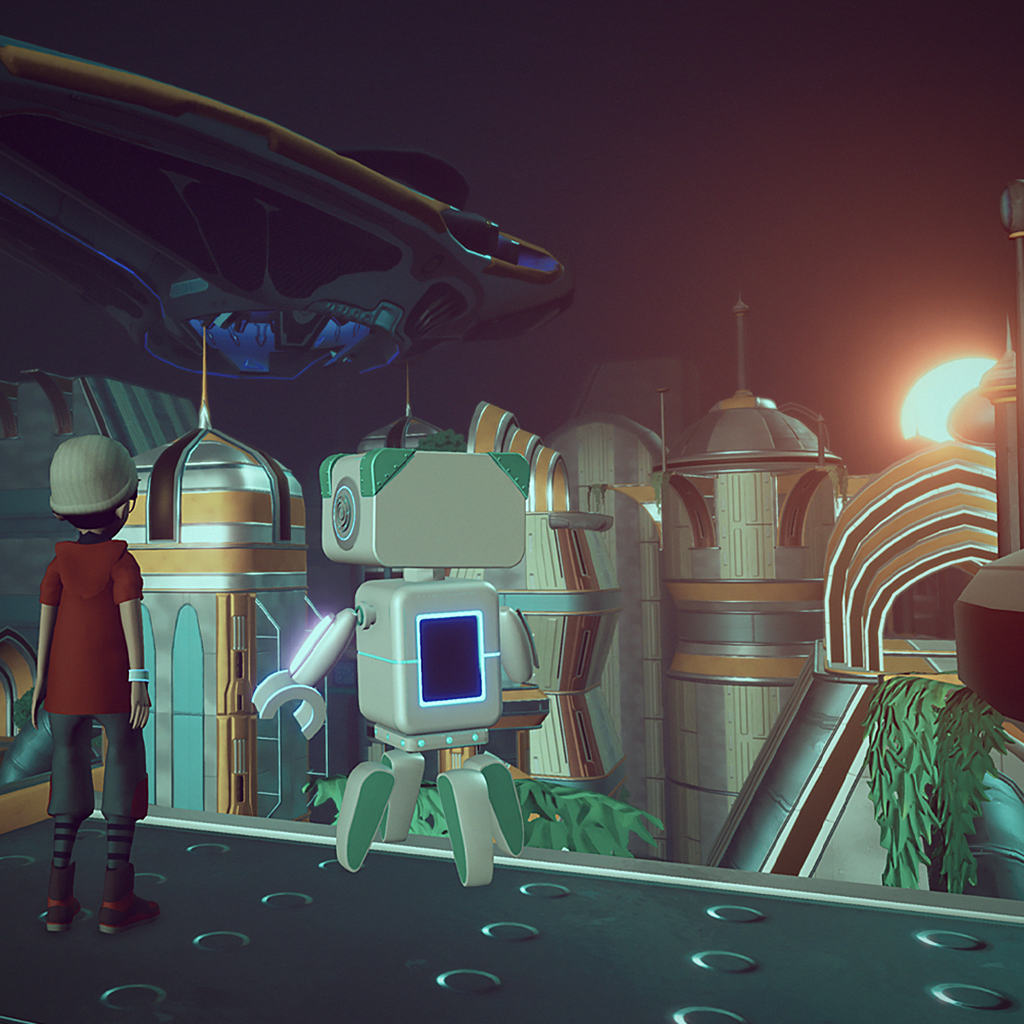
04 · Cognitive Skill-Building & Educational Action-Puzzle Adventure
GameIT
Role
Lead Game Designer
Engine
Game Design Documentation, Puzzle & Level Architecture, Behavioral Telemetry Systems, Interactive 3D Engine
Platform
Released on GameIT Platform (Web / Tablet / PC)
Gallery
01
Project Overview
GameIT is an interactive learning platform selected by Microsoft for Startups that empowers children to build essential life and cognitive skills through data-driven video games, providing parents and educators with measurable behavioral insights. As Lead Game Designer, I spearheaded the design of two interconnected flagship narrative chapters starring a young hero named Azzo and his loyal robot companion, Gizmo:
Chapter 1: Gizmo & Azzo’s Adventure (Focus: Working Memory & Spatial Recall): Following an alien invasion that drains Earth's energy and captures Azzo's family, players guide the duo across hazard-filled zones, solving environmental puzzles designed to train and evaluate memory retention.
Chapter 2: Saving the Energy (Focus: Auditory Perception & Sound Discrimination): Azzo and Gizmo infiltrate a secret laboratory where players must solve frequency and audio-based puzzles, collect energy cores, neutralize alien threats, and rescue trapped civilians.
02
My Role & Core Responsibilities
As Lead Game Designer, my mandate was to bridge developmental psychology and behavioral data science with genuinely fun, intrinsically motivating adventure gameplay:
- Defined the core gameplay loops, dual-character companion mechanics (Azzo and Gizmo), and narrative progression across both Gizmo & Azzo’s Adventure and Saving the Energy.
- Translated clinical cognitive rubrics (working memory span, spatial recall, auditory discrimination, and sound sequencing) into tactile in-game puzzle mechanics and level challenges.
- Designed adaptive difficulty progression curves and non-punitive hint systems tailored for young players.
- Collaborated with AI/data engineers and educators to map in-game player actions (reaction times, sequence accuracy, retry patterns) to background behavioral telemetry without disrupting immersion.
03
From Idea to Implementation (Behind the Scenes)
Most educational games fail because they bolt quiz questions onto generic platforming, immediately making kids feel like they are being tested. From the initial concept phase, I insisted that the cognitive skill must be the core gameplay verb. We started by breaking down the exact cognitive targets with specialists: how many items a child needs to hold in working memory, or how closely spaced two audio frequencies should be for intermediate auditory perception. I then paper-prototyped puzzle rooms where those exact mental actions served as the key to bypassing alien security systems, powering up Gizmo, and rescuing civilians.
04
Key Challenges & How I Solved Them
Challenge 1: Disguising Clinical Cognitive Assessments as Diegetic Adventure Mechanics
The Problem: We needed to capture rigorous, repeatable data on a child's memory skills and auditory perception across multiple sessions without using UI pop-up tests that cause test anxiety and boredom.
The Solution: In Gizmo & Azzo’s Adventure, I embedded memory challenges directly into the world architecture: players observe environmental energy surges, alien patrol sequences, and Gizmo's holographic projections, then physically navigate and trigger power nodes in matching or reverse orders to restore Earth's grid. In Saving the Energy, I transformed the secret laboratory into an interactive acoustic space where alien locks, energy conduits, and civilian containment pods emit distinct audio cues and sound sequences. Players must actively listen, discriminate between subtle sound patterns, and sequence audio triggers to outsmart alien guards and collect energy.
Challenge 2: Balancing Frustration vs. Data Accuracy Through Dynamic Scaffolding
The Problem: If a memory or auditory puzzle is too hard, young players get frustrated and guess randomly, which ruins both the fun and the validity of the behavioral data. If it is too easy, the system cannot measure their true developmental growth.
The Solution: I designed an adaptive scaffolding system centered around Gizmo, the robot companion. Instead of flashing a "Wrong Answer" screen, failed attempts trigger subtle, diegetic assists from Gizmo (such as re-pulsing an audio cue or illuminating the first step of a memory path) while dynamically adjusting the sequence length on the next encounter. This kept players in a confident flow state while giving our data platform clean telemetry on assisted versus unassisted mastery.
Earthlings
Open-World Steampunk Fantasy RPG, Narrative Companion Adventure & Battle Royale · Unreal Engine, Animation Blueprints, State Machines, Blender, World Partition