09 · 3D Action-Platforming & Stylized World Reconstruction
TightWire Adventures
Role
Lead Environment & Level Designer
Engine
Unreal Engine 5, Blender 4.3, Blosm Pro, Google 3D Tiles
Platform
iOS · 2026 (Currently in development)
Team
Confidential
Gallery
01
Project Overview
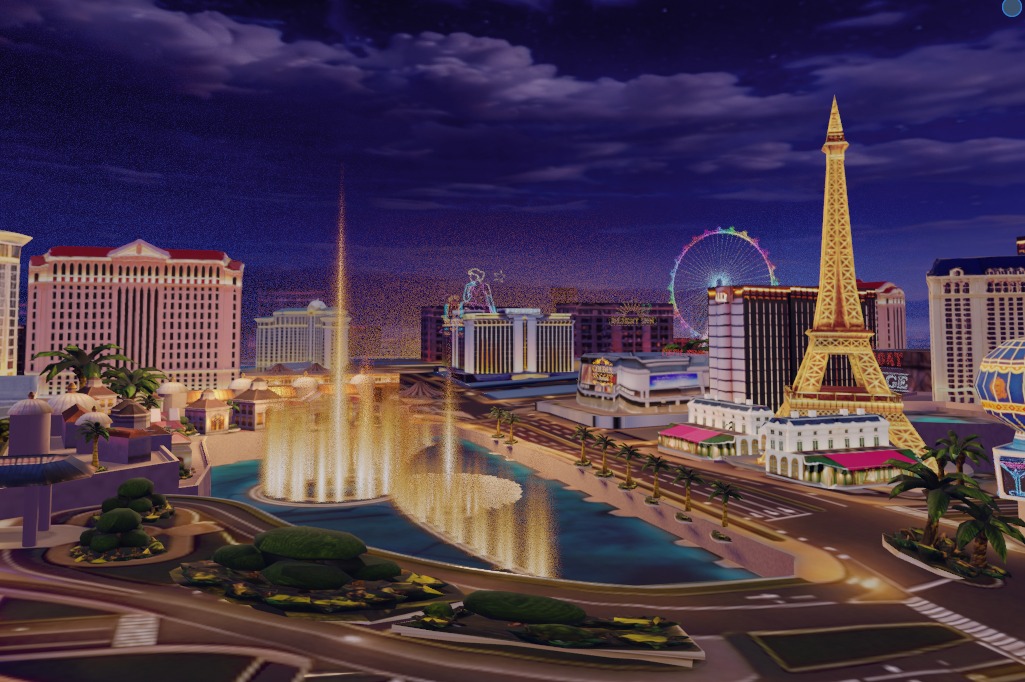
TightWire Adventures is a modern Unreal Engine 5 reconstruction of an action-traversal game spanning fifteen distinct themed 3D environments. A flagship centerpiece of the modernization effort is a sprawling Las Vegas ("Sin City") level that places players high above iconic resort architecture, neon boulevards, and landmark facades.
02
My Role & Core Responsibilities
Leading the environment reconstruction and level modernization pipeline, I bridged geospatial data workflows with playable Unreal Engine 5 level design:
- Architected the production pipeline across fifteen themed 3D environments using Unreal Engine 5 and Blender 4.3.
- Utilized Blosm Pro and Google 3D Tiles to extract real-world urban proportions and landmark footprints for the Las Vegas level, converting raw photogrammetry reference into clean, modular game geometry.
- Designed high-altitude traversal paths, camera framing, and custom emissive night-time lighting setups optimized for real-time gameplay.
03
From Idea to Implementation (Behind the Scenes)
Rebuilding fifteen themed environments required a fast, repeatable pipeline that did not sacrifice visual scale. For the Las Vegas Strip level, manually modeling an entire city boulevard from scratch would have bottlenecked production. Instead, I pulled real-world spatial data into Blender 4.3 using Blosm Pro and Google 3D Tiles to capture authentic street widths, building heights, and skyline silhouettes. From that spatial baseline, I replaced messy scan meshes with clean, modular hero landmarks, custom emissive window maps, and optimized UE5 materials tailored specifically for high-wire traversal gameplay.
04
Key Challenges & How I Solved Them
Challenge 1: Converting Raw Google 3D Tiles into Performant, Playable Game Geometry
The Problem: Raw 3D tile imports have dense, unoptimized topology, baked-in lighting artifacts, and irregular collision that are unusable for close-up gameplay or dynamic night-time lighting in Unreal Engine 5.
The Solution: I used the imported tiles strictly as an accurate 1:1 spatial greybox in Blender 4.3. For foreground and mid-ground buildings along the player's tightwire path, I modeled clean modular architectural kits and hero landmarks with custom UV channels and procedural emissive shaders, while retopologizing distant city blocks into lightweight low-poly skyline meshes.
Challenge 2: Maintaining Depth Perception During High-Altitude Traversal
The Problem: When players navigate narrow paths high above a brightly lit city at night, visual noise from neon signs and distant streetlights can obscure the foreground platforming path.
The Solution: I separated the visual hierarchy by color temperature and atmospheric fog density in Unreal Engine 5, placing warm, high-contrast lighting and clear architectural framing on the immediate traversal anchors while pushing the street-level neon glow into a softer volumetric layer below.
Lighting Navigation Level Blockout
Level Blockout · Unity