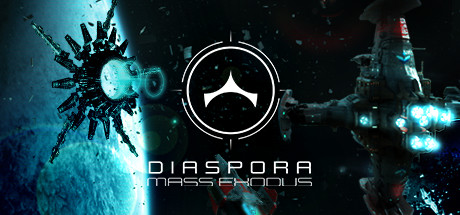
03 · 2D/3D Space RPG MMO & Tactical Point-and-Click Simulation
Diaspora: Mass Exodus
Role
Lead Game Developer and Designer
Engine
Unreal Engine 4, Blueprints, Multiplayer Networking, Custom HUD & Telemetry Systems
Platform
Released on Steam (PC)
Gallery
01
Project Overview
Diaspora: Mass Exodus is a free-to-play 2D/3D RPG MMO built in Unreal Engine 4 that revives and modernizes the cult-classic 1999 tactical space simulation. Players command customizable spacecraft across six distinct classes and seven hull types, forging their own path across multiple solar systems. Whether trading commodities, mining asteroid fields, hunting bounties, managing planetary colonies, or engaging in territorial guild warfare, the entire galaxy runs on player-driven interactions.
02
My Role & Core Responsibilities
As Lead Game Developer and Designer, I owned the end-to-end technical implementation and systemic game design required to bring a legacy browser-era concept into a modern Unreal Engine 4 production pipeline:
- Architected the core gameplay loop integrating point-and-click spatial navigation with real-time 3D ship assets and orbital physics.
- Designed the progression matrix across 6 ship classes and 7 ship types, balancing hull durability, cargo capacity, weapon hardpoints, and warp speeds.
- Built the persistent economic and social systems, including commodity trading routes, asteroid resource extraction, planetary upgrades, and a full guild management and banking framework.
- Designed and implemented the dual-screen tablet cockpit HUD, giving pilots simultaneous access to radar telemetry, sector navigation, cargo management, and live comms.
03
From Idea to Implementation (Behind the Scenes)
The core vision was to capture the high-stakes tension of classic tactical space trading games while upgrading the visual fidelity and responsiveness using Unreal Engine 4. We started by mapping out the galaxy topology on paper, defining how solar systems connect through jump gates and how resource scarcity would drive player movement between safe starter zones and lawless outer sectors. From there, I prototyped the point-and-click flight controller in UE4, iterating on camera distance, ship turn rates, and target-lock feedback until navigating crowded asteroid belts and engaging hostile pilots felt deliberate and tactical.
04
Key Challenges & How I Solved Them
Challenge 1: Bridging 2D Tactical Readability with 3D Unreal Engine Environments
The Problem: The original game relied on flat 2D spatial clarity. Moving into a 3D engine risked cluttering the screen, distorting distance perception during point-and-click movement, and overwhelming players with complex UI windows during live combat.
The Solution: I engineered a constrained orbital plane navigation system in Unreal Engine 4 that preserved crisp 2D tactical decision-making while leveraging 3D lighting, ship models, and VFX. To solve UI overload, I designed an integrated "spaceship cabin" tablet HUD mode with side-by-side telemetry panels, expanding the player's effective field of vision while keeping targeting, shield status, and trade data one click away.
Challenge 2: Preventing Veteran Bottlenecks in a Player-Driven PvP Economy
The Problem: Because the game relies heavily on PvP risk and open-world trading, early playtests showed that heavily armed veteran players could camp primary trade routes and lock new pilots out of economic progression.
The Solution: I restructured the galaxy layout into tiered security sectors, starting with a protected "Gen Zone" tutorial and onboarding sector where new pilots learn trading and mining fundamentals safely. I also rebalanced ship class stats so dedicated trading vessels had high sub-warp evasion windows and shield buffer timings, forcing attackers to coordinate in guilds rather than solo-ganking cargo runners.
GameIT
Cognitive Skill-Building & Educational Action-Puzzle Adventure · Game Design Documentation, Puzzle & Level Architecture, Behavioral Telemetry Systems, Interactive 3D Engine